
How Prices Actually Work
Why Your Gas, Your Lumber, and Your Coffee All Answer to a World You've Never Seen

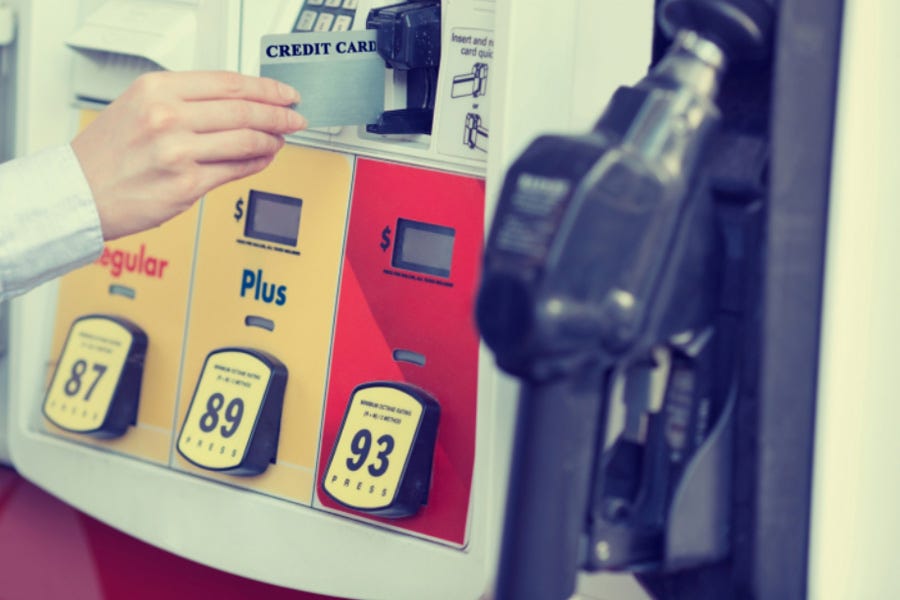
Every so often a story comes along that’s built entirely on a misunderstanding, and the misunderstanding is so widely shared that the story just sails along unchallenged. Gas prices are one of those stories. It comes back every time crude oil drops and the pump doesn’t drop as fast: somebody, somewhere, must be ripping you off. It’s an emotionally satisfying story. It is also almost entirely wrong — not wrong as a matter of opinion, wrong as a matter of how the machine actually works.
Even the President of the United States gets in on the game.
This past week the charge came straight from the President, who suggested Big Oil was gouging drivers and floated sending the Justice Department after them. So I spent some time on-air walking through the actual mechanics, and my listeners — who are sharp, and who ask better questions than most people I’ve ever cross-examined — kept pulling the thread further. What about American oil that never crosses an ocean? Do other commodities work like this? Lumber?
Those questions turned out to build, one on top of the next, into the whole picture of how prices are really set in a modern economy. So here it is, start to finish. Once you see it, you’ll never fall for the gouging story again — and better yet, you’ll be able to explain it to the person at dinner who’s still falling for it.
Part One: The Pump Is a Conveyor Belt, Not a Light Switch
Start with the thing everybody gets wrong first: who owns the gas station. The sign out front says Shell or Exxon or Conoco, and people assume that means an oil giant is setting the price. It almost never does. That’s a brand license and a fuel-supply contract. The overwhelming majority of the roughly 145,000 fueling stations in this country are owned by independent operators — a family, a small local chain, a convenience-store company. The person setting the price on that big lit-up sign is a local businessman, not a boardroom in Houston.
And that local operator prices his gasoline off exactly one number above all others: what the last tanker truck of fuel cost him. He bought that load a few days ago at a certain wholesale price. He has to sell it, replace it, and clear a few cents a gallon in the middle to keep his lights on. He cannot sell today’s gas for less than what tomorrow’s replacement load is going to cost him, or he’s out of business by Labor Day. So the price on the sign is anchored to inventory he already paid for — not to the crude oil ticker scrolling across your television this morning.
That’s the whole reason for the famous “lag.” When crude drops, that cut doesn’t teleport to your neighborhood. It has to travel down a long, physical chain, and every link takes time. The barrel itself is slow — an oil tanker crosses oceans at roughly the speed of a bicycle, so cheaper crude leaving the Persian Gulf today doesn’t reach a U.S. port for weeks. The refinery is a price-taker, not a price-maker: it pays market rate for whatever cargo shows up at its dock, and the crude it’s running right now was bought and paid for a couple of weeks ago, when the price was higher. And your corner station is still pricing off the last truck it took delivery of.
Add it up and you don’t get a switch you can flip. You get a real decline that arrives in stages. Which, by the way, is exactly what’s happening — pump prices have fallen substantially over the past month even as the expensive, already-purchased crude works its way through the system. If the oil companies were secretly conspiring to hold prices high and rob you blind, they’d be doing a spectacularly bad job of it, seeing as your fill-up has gotten meaningfully cheaper.
One more thing worth knowing, because it’s the part that never lands: Washington has leveled the “price gouging” charge at the oil industry for fifty years. Every spike, out come the podiums and the subpoena threats. And in all those decades, all those federal investigations, the number of times a probe actually found a major oil company guilty of gouging is zero. Not “rarely.” Zero — because the thing they keep hunting for isn’t there. The pump price is the output of a slow, physical, competitive supply chain, not a conspiracy.
Part Two: But What About Our Own Oil?
Here’s where my listeners got sharp on me, and it’s a genuinely good objection. Fine, tankers are slow — but a huge share of the oil we refine comes right out of Texas and North Dakota. It never touches a ship, never crosses an ocean, never goes anywhere near the Strait of Hormuz. So why should that oil be priced off some international event? Why does a barrel out of the Permian Basin cost whatever the ships from the Gulf are charging?
The answer is the single most important idea in this whole essay, so let me put it plainly: oil is a globally traded, fungible commodity, and its price is set on a world market — not by where any particular barrel happens to come out of the ground.
Picture yourself as a producer in West Texas. Say it costs you forty dollars to get a barrel out of the ground, and the world price is seventy. Are you going to sell it to the refinery down the road for forty-five out of neighborly goodwill? Of course not. You’ll sell it for seventy — because if that Texas refinery won’t pay the going rate, you’ll put your barrel on a ship and sell it to a refinery in Rotterdam or Singapore that will. Your oil can go anywhere. And precisely because it can go anywhere, it commands the world price no matter where it actually ends up.
That’s what fungible means in practice. A barrel of comparable crude is a barrel of comparable crude whether it’s sitting in Midland or Riyadh — the molecules don’t know their zip code. And nobody on earth sells a globally tradeable asset for less than the global market will pay. That’s not gouging. That’s just refusing to leave money on the table, which is a thing no business does voluntarily.
There’s a nuance worth having in your back pocket. American crude isn’t priced off Brent, the international benchmark, exactly — it’s priced off WTI, West Texas Intermediate, our domestic benchmark, which usually trades a few dollars below Brent. So our oil is often a touch cheaper than the imported stuff. But WTI and Brent move together. They’re two corks bobbing on the same ocean. When the world price rises or falls, both benchmarks rise and fall in near-lockstep, because they’re pricing the same global supply-and-demand picture. Being priced off WTI doesn’t insulate our oil from world events — it just means it rides the same wave at a slightly different height.
So when the Strait of Hormuz seizes up and Brent spikes, WTI spikes right alongside it, even though not one barrel of West Texas crude goes anywhere near Hormuz. That feels wrong to people. It isn’t. It’s simply what a single global market for a fungible good does. And — this is the part to hold onto — it cuts both ways. As the world price comes down, WTI comes down with it, and our domestic oil gets cheaper right alongside the imported oil, for the exact same reason. You don’t get to keep the domestic discount when prices are high and then complain about the linkage when prices fall. It’s one market, and it works in both directions.
Part Three: Oil Isn’t Special — It Just Has the Biggest Sign
The last question my listeners asked was the one that ties the whole thing together: does anything else work like this? Lumber?
Yes. Oil isn’t a weird exception. It’s just the commodity you happen to stare at twice a week on a giant sign by the road. Nearly everything that gets dug up, grown, or refined at scale prices the same way.
Take lumber, since somebody asked. A two-by-four is a two-by-four. A sawmill in Oregon isn’t selling to the local yard at some cozy neighbor price while the rest of the country pays more — it sells at whatever the market is paying, because that same wood can be loaded on a railcar and sent to Denver or Atlanta or Toronto. You watched this happen in real time during COVID: lumber futures went vertical, quadrupled, and the two-by-fours at your hardware store shot up right alongside them, even though the wood didn’t suddenly cost more to grow. Demand spiked, mills couldn’t keep up, and the futures price dragged the physical boards up with it. Then the frenzy broke and it all came back down. Nobody was gouging. Same machine, different plank.
Lumber even has its own version of the pump lag. The futures crash, but the boards already sitting in your local yard were bought at the peak, so retail prices come down after the futures do — days or weeks later. Same conveyor belt, different product.
Once you know what to look for, you see it everywhere. The energy complex — crude, gasoline, heating oil, natural gas. The metals — gold, silver, copper, aluminum; traders literally call copper “Dr. Copper” because it’s so globally priced and so tied to industrial demand that it forecasts the world economy. And the agricultural commodities — wheat, corn, soybeans, coffee, sugar, cattle. This is where it gets vivid: a drought in Brazil spikes your coffee, and a war in Ukraine — one of the world’s great wheat baskets — raises the price of bread in Kansas, even though Kansas grows plenty of its own wheat. Why? Because Kansas wheat can be sold onto the world market, so it commands the world price, and the world just lost a huge chunk of supply. Same exact logic as West Texas crude spiking over an event in Hormuz. The grain never left Kansas. The price moved anyway.
There’s even an exception that proves the rule, and it’s worth knowing because it’s the tell. Natural gas is harder and far more expensive to ship across oceans — you have to super-chill it into LNG — so it’s priced more regionally than oil. American natural gas is genuinely, dramatically cheaper than European or Asian gas, precisely because it can’t freely flow to the highest bidder the way a barrel of oil can. That’s the whole principle in one data point: the easier something is to transport, the more perfectly it obeys one world price. The harder it is to move, the more local its price stays.
The One Rule Underneath All of It
Strip away the specifics and every bit of this reduces to a single idea. If a thing is standardized enough that one unit is interchangeable with another, and portable enough to be shipped to the highest bidder, then it stops having a local price and starts having a world price. Geography stops mattering. The barrel, the board, the bushel, the ingot — none of them get sold to your neighbor for less than a stranger across the ocean will pay.
That’s not a conspiracy against the American consumer. It’s the same neutral mechanism that raises your coffee over a Brazilian drought, your bread over a war in Ukraine, your framing lumber over a building boom, and your gasoline over trouble in a strait most Americans couldn’t find on a map. It also, quietly and less dramatically, lowers all of those things when the world’s supply-and-demand picture eases — which is exactly what’s happening at the pump right now.
So the next time someone tells you the oil companies are gouging you because gas didn’t drop fast enough, you’ll know the real answer. The barrel is slow. The refinery already bought expensive oil. Your corner station is pricing off its last delivery. And the price of all of it is set not by anyone’s greed but by a global market doing precisely what it has always done. It’s not a scandal. It’s a calendar and a map.
Your family, friends, coworkers, may believe there is a Big Oil conspiracy. There isn’t. Share this with them.
I have been listening to your radio show this morning. Your experiences as an oil and gas lawyer and as Under Secretary of Homeland Security & FEMA Director are invaluable. I switched the channel to CPR and caught the tail end of an interview with Melat Kiros. OMG! She’s so dumb. Her strategy to fund universal healthcare is to share with us her moral clarity on healthcare, childcare, and civil rights. Would you consider running for office, as a service to our country?